
Found Poems in Altered Books
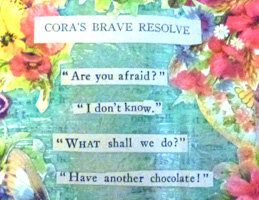
Found Poems in Altered Books ~ Finding Your Voice
One of the most enjoyable things about the process of creating an altered book is being able to “re-vision” the author’s intended purpose for the book and make it your own. You can do this by not only embellishing the book with art work, but by using the text of the book to create found poetry.Before you start gluing pages and cutting niches, skim through the pages and look for interesting words, phrases, sentences, and paragraphs that make you pause for a second look. Put a sticky note in the margin with an arrow to mark the text and then keep going. You don’t need to read every word on the page, but don’t be surprised if you find yourself slowing down to read the story.
After you’ve scanned through a section or chapter, go back and cut out the entire page. Place a cutting mat under the page you want to remove and use an exacto knife to slice through the paper. Cut at least 1/4″ from the gutter, and try to stagger the distance from the gutter on each page you remove.
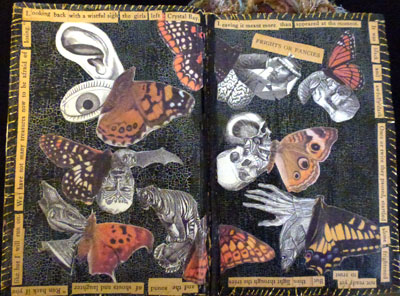
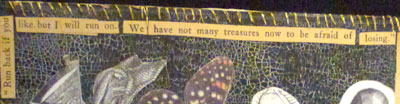
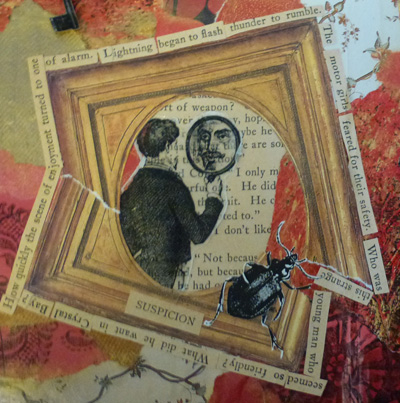
The examples above are from my altered book The Motor Girls on Crystal Bay.
Cut out the words and phrases that you like from the pages you removed. Don’t throw the extra pages away. You may need some additional text to help create your found poem.
Take the strips of text that have been cut from the page and place them in a tray or shoebox lid so they’re less likely to blow away. Move the text strips around, playing with their position in the poem.
Remember, this should be fun! Don’t worry about complete sentences or rhyming or making perfect sense. Try to play with the language the same way you play with your paints and ephemera. Cut out additional words from your reserved pages as necessary, or discard phrases that don’t seem to fit. The most powerful poetry often has a strong sense of rhythm and visual imagery. Consider the flow of words and how they will enhance your altered page. If things don’t seem to be going well, walk away for a while or work on your art. When you come back later, fresh ideas will come into your head.
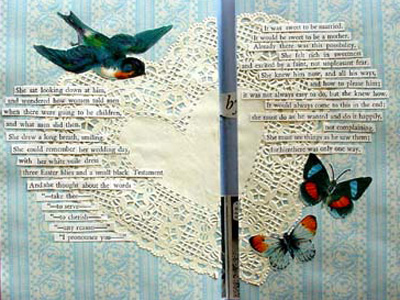
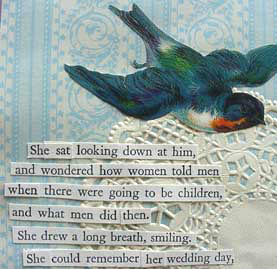
The two examples shown above are from my altered book As the Earth Turns.
Once your poem has been found, think about how to place it on the page. You can place your text strips around the outside edges of the book or wrap them around a window or an image in the book. You can place the text on tags that are attached to the book or sandwich the text within the layers of an embossing tile. In addition, you can cluster your words in the center of a page, run them across a double page spread, or place them inside or beneath a niche.
After you’ve checked the placement of your poem on the page, use any lightweight glue, such as Perfect Paper Adhesive, PPA, or Sobo craft glue to adhere the text. A good pair of tweezers is useful for holding the thin strips of text while you apply the glue and for placing then on the page.
When you’re finished, you’ll discover that your found poetry has provided you with an additional creative voice and added a whole new dimension to your altered book.